Green coffee trading
Sourcing green coffee from producers, exporters and regional distributors, with attention to origin, quality, specifications and commercial terms.

Sourcing green coffee for roasteries, importers and distributors in Oman, the UAE and Iran.
Atlas Earth is an international trading and business development company based in Oman, with a focus on the coffee industry. We connect suppliers and business buyers across Oman, Iran, the UAE and selected international markets.
Our approach brings together supplier evaluation, commercial negotiation and cross-border coordination, with the goal of turning individual transactions into lasting trading relationships.
Sourcing green coffee from producers, exporters and regional distributors, with attention to origin, quality, specifications and commercial terms.
Identifying and evaluating supply partners. Comparing quality, availability, documentation, lead times and the full cost of a transaction.
Developing supply relationships with roasteries, coffee companies, distributors and hospitality businesses across priority regional markets.
Supporting investors and business owners who plan to trade in Oman, from activity selection and document preparation to licensing pathways and local coordination with the relevant authorities and professional advisers.
Explore wholesale green coffee beans by destination or origin. Share your specification, quantity and delivery requirements to request a quotation.
Browse all · Green coffee beans


Other origins are considered according to product requirements and commercial opportunity. Availability and specifications are confirmed for each inquiry.
Our operational and commercial base
A priority market for coffee and B2B trade
A regional sourcing and logistics hub
Define the product, destination, volume and delivery requirements.
Review suppliers, specifications, documentation and commercial terms.
Align the agreement, shipping requirements and delivery arrangements.
Six stages show how coffee moves from the fruit on the tree to the final cup. Atlas focuses on the sourcing, specification, documentation and export stages before shipment.
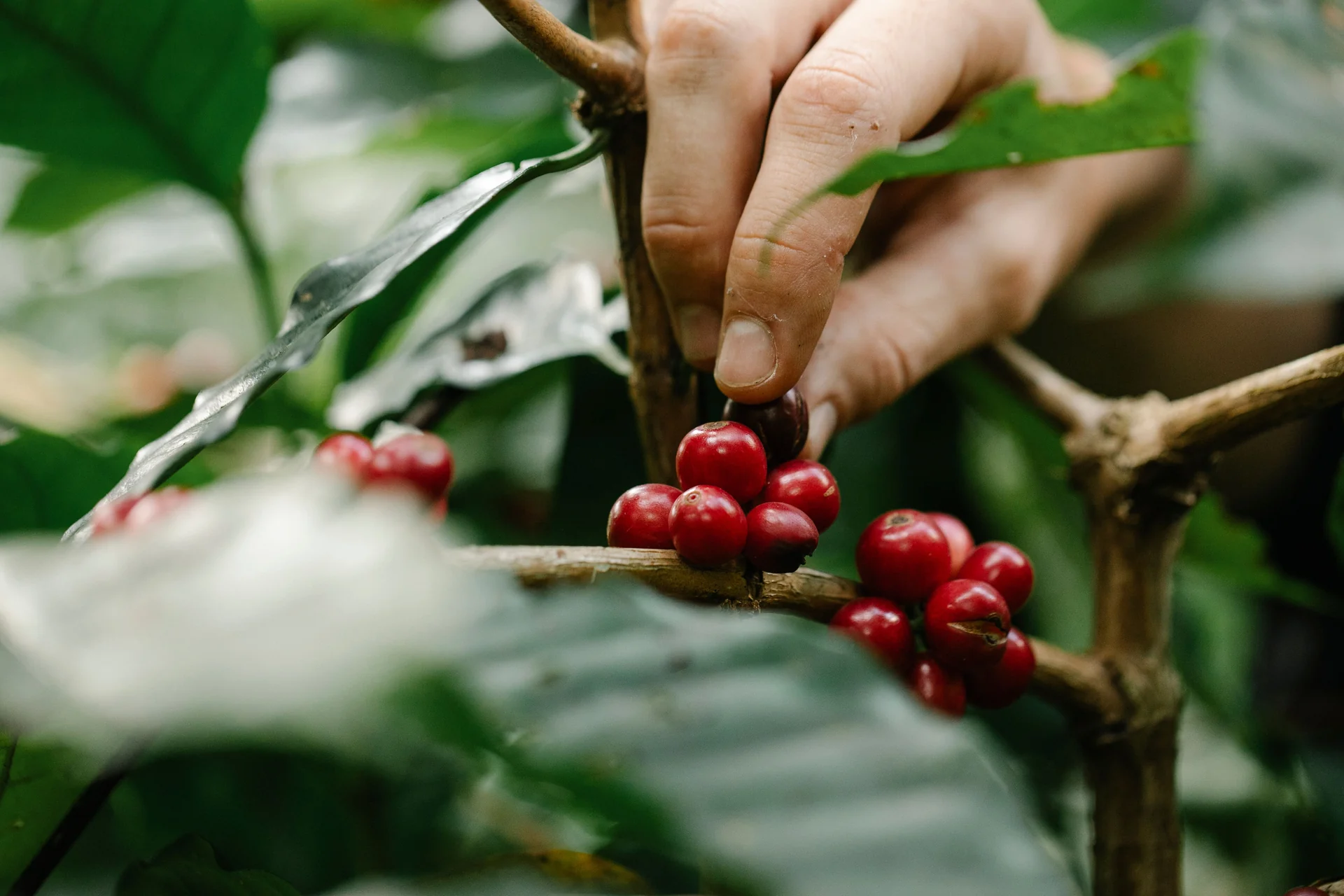
Coffee cherries are harvested selectively or mechanically, depending on the origin, terrain, farm and quality requirements.
With washed, natural or honey processing, the fruit is removed before or after drying and the coffee is brought to a stable moisture level.
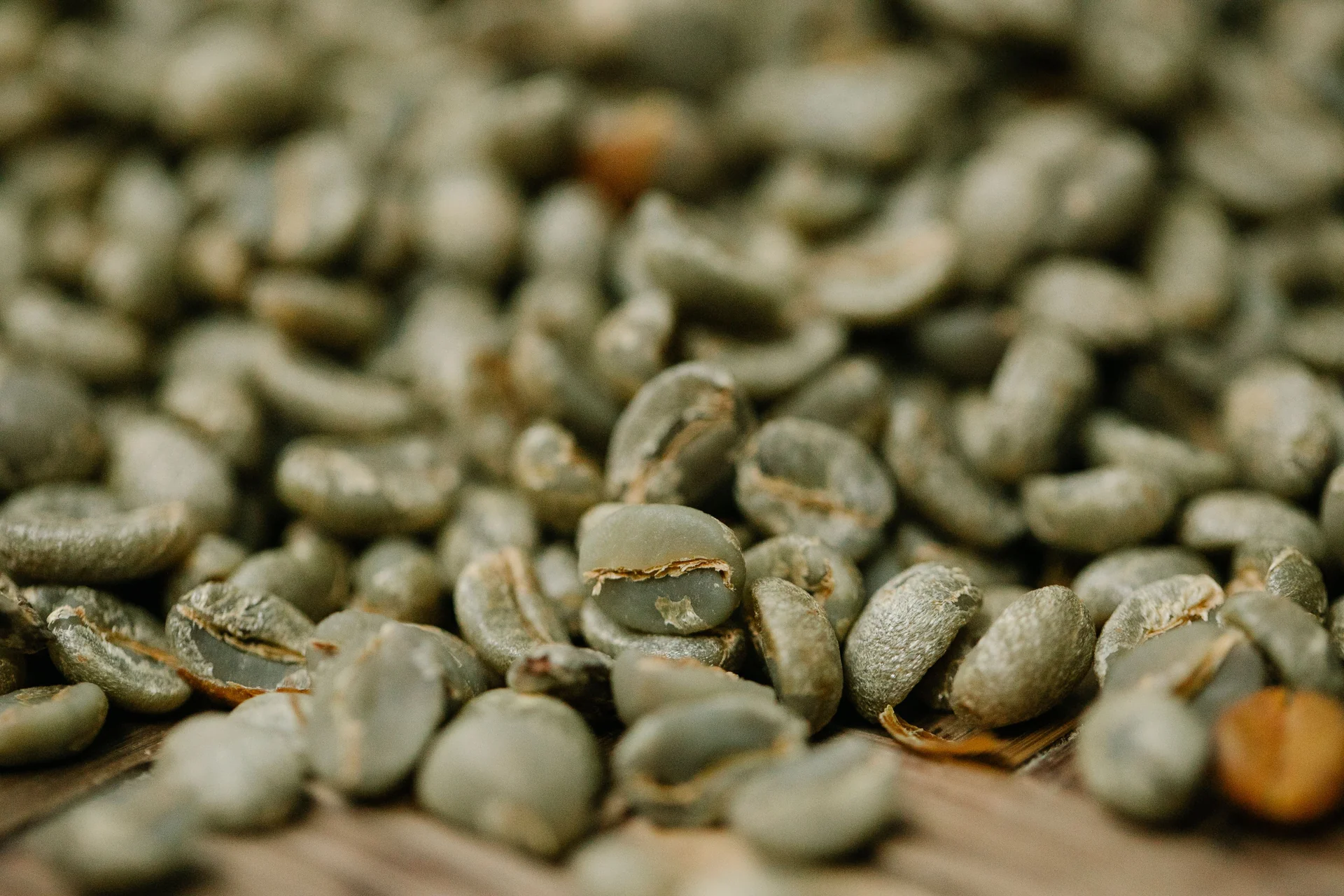
The coffee is hulled, graded, sampled and packed as green coffee before its documents and shipment plan are confirmed.
The roaster applies heat according to a target profile, developing the coffee’s aroma, acidity, sweetness and body.
Grind size is selected for the brewing method, from coarser immersion grinds to finer espresso settings.
Water extracts soluble compounds from the ground coffee into the cup—the final expression of the work completed across the chain.
A practical learning series for buyers, roasters and coffee professionals.
A fruity, bright sample can be described clearly without deciding whether it suits your menu. The SCA Coffee Value Assessment separates descriptive sensory observations from affective judgments about quality, while physical and extrinsic information form separate assessments. For a roaster, this makes a cupping note more useful than a single unexplained score.
Use two clear notes: what the sample shows and whether it fits your intended use. The SCA framework helps separate those judgments; it does not replace a written specification or confirm that a later lot will match. Send sourcing requirements through the website contact section; the form prepares a WhatsApp draft for you to review and send.
Explore green-coffee sourcingUse roasted coffee, not green beans. This two-serving guide adapts James Hoffmann’s recipe published by HARIO Europe. It is a starting point, not an Atlas-tested recipe or a Seen menu item. Use a size-02 V60 with matching paper, a server, grinder, scale, timer and controlled-pour kettle.
Keep the coffee, water and pouring pattern consistent. If the cup is sharp and thin with a fast drawdown, try a slightly finer grind; if it is harsh and drying with a slow drawdown, try slightly coarser. These are trials, not diagnoses: roast, water and uneven wetting also matter. Taste as it cools and log dose, grind, temperature, time and result. For buying decisions, compare roasted samples under the same method; this brew does not replace physical grading or a formal cupping protocol.
Explore green-coffee sourcingA clean-looking sample is a starting point, not a cup-quality guarantee. The SCA separates physical assessment—colour, defects, moisture and size—from sensory assessment. Screen analysis describes bean-size distribution; defect assessment describes physical faults. They answer different questions and should accompany a representative sample and cupping.
For Oman, UAE and Iran buyers, compare offers on the same testing basis. A larger bean is not automatically a better purchase. Send your sourcing requirements through the website contact section; the form prepares a WhatsApp message that you review and send.
Send a sourcing enquiryProcessing describes how the fruit is removed and the seed is dried after harvest. In natural processing the whole cherry dries around the seed; in washed processing the skin, pulp and mucilage are removed before drying; honey processing removes the skin while retaining a controlled amount of mucilage during drying. These labels help explain production choices and potential cup character, but they do not guarantee quality or consistency.
Do not approve a lot from the process name alone. Compare the representative sample with the written process record, moisture, physical defects, cup result, storage history and shipment specification. Put the accepted sample code and measurable tolerances into the contract.
A country name is only the first layer of origin. Commercially useful origin data moves from country to region or subregion, then to the farm, estate, cooperative or washing station, and finally to a traceable lot. Elevation, harvest timing and local growing conditions can help explain expected availability and cup potential, but none of them replaces sampling and written specifications.
Use origin information to narrow sourcing risk and build a testable expectation—not to approve quality in advance. The purchase decision should still depend on a representative sample, physical assessment, cup result, lot traceability, shipment window and landed cost.
Species, variety and origin describe different things. World Coffee Research notes that most historic Arabica varieties descend from Typica and Bourbon; later breeding introduced rust-resistant varieties and, more recently, genetically diverse F1 hybrids. Robusta has broad genetic diversity rooted in western sub-Saharan Africa. A variety name can indicate genetic and agronomic potential, but it does not by itself guarantee cup quality.
Treat a variety name as one verified field, not as a quality certificate. Cup the representative sample and assess it together with origin, process, sorting, moisture, storage history and landed cost.
Coffea arabica and Coffea canephora—often called Robusta—are different species, not simply two quality grades. Their genetics, preferred growing conditions and fruit development differ, influencing flavor precursors and roasting behavior. Arabica is often associated with greater aromatic complexity, while Canephora can offer higher caffeine, body, resilience and different commercial applications; quality exists across both species.
Never purchase on the species name alone. Match the intended product, target cup profile, landed cost and risk tolerance to a verified pre-shipment sample and a written specification.
From 9 to 16 October, the ICO composite indicator rose from 258.53 to 265.95 US cents/lb (+2.87%). Colombian Milds rose 3.95%, Other Milds 4.09% and Brazilian Naturals 4.53%, while Robustas fell 1.61%. These changes compare the two verified Friday observations, not weekly averages. The October report was checked on 20 October; its 19 and 20 October rows were blank.
For roasters, importers and distributors in Oman, the UAE and Iran, one composite percentage is a poor substitute for a buying budget built around the actual coffee required. Keep Arabica and Robusta requirements separate, and compare each offer against the appropriate dated benchmark. A falling Robusta indicator does not establish that a suitable physical lot is cheaper or available. Ask for a written offer with the crop, grade, process, quantity, currency, validity and named delivery basis made clear. Separate freight and destination costs from the coffee quotation. Where a blend change is being considered, assess the sample and its intended use before treating a different coffee as a substitute. Record the benchmark date used in each comparison, and revisit the calculation when a newer complete observation is published. This is a procurement framework, not a forecast, an offer or confirmation of Atlas stock. Review the dated indicators. For transaction-specific requirements, use the website contact section and review and send the WhatsApp draft it prepares.
View the latest dated ICO indicators and recent observations
ICO October 2026 daily report: observations 9, 15 and 16 October; checked 20 October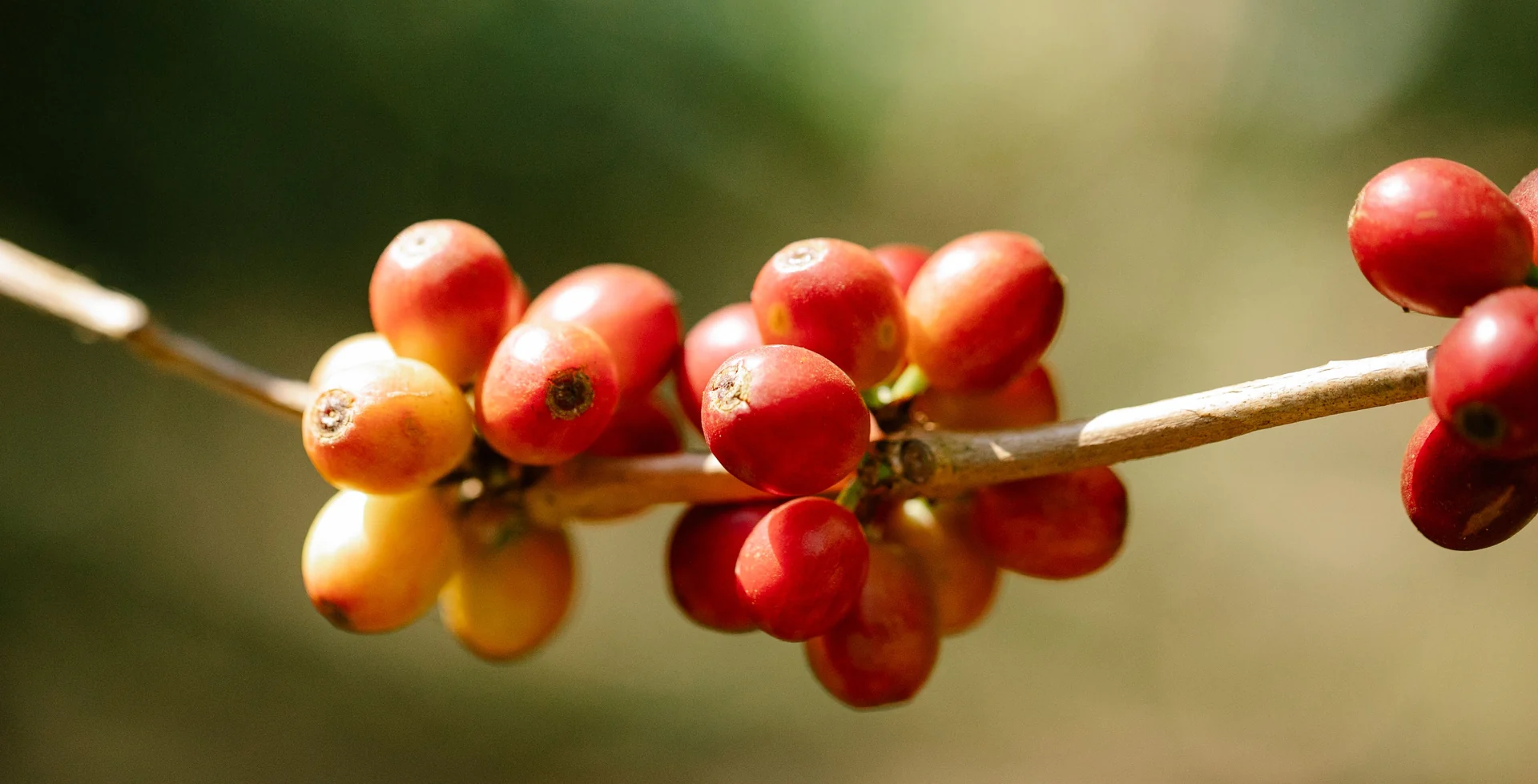
Cecafé reports that Brazil exported 3.894 million 60-kg bags in September 2026, up 3.1% year on year, while revenue fell 7.1% to US$1.282 billion. These totals cover all forms of coffee. The report was published on 9 October; this weekly review was checked on 13 October.
For roasters, importers and distributors in Oman, the UAE and Iran, the useful next step is to request comparable written offers, not apply the revenue decline as a blanket discount. Keep species, crop, grade, process, sample approval and shipment window identical before comparing price. Separate the origin quotation, freight, insurance and destination charges so a cheaper headline does not conceal a higher delivered cost. For essential supply, map expected consumption against confirmed stock and realistic arrival dates. For discretionary purchases, compare a staged order with a larger commitment, including storage capacity and working-capital needs. If the preferred grade is unavailable, assess an alternative sample before changing the blend; export growth alone does not prove substitutability. Record offer validity and the agreed named place and Incoterm. These are procurement planning choices, not a price forecast or confirmation of Atlas inventory. Send transaction-specific requirements through the website contact section; review and send the WhatsApp draft it prepares. Dated ICO indicators
Cecafé reports September exports of 3.894 million 60-kg bags, up 3.1% year on year. Export revenue fell 7.1% to US$1.282 billion. These totals cover coffee exports, not only green coffee.
Aggregate export figures do not establish current lot availability or an Atlas quotation. Buyers in Oman, UAE and Iran should compare grades, samples and written shipment terms.
The ICO September 2026 report records August green-bean exports of 10.94 million 60-kg bags, up 15.6% year on year. Robusta rose 22.4%; Colombian Milds fell 5.6%. These are August trade figures, not current stock.
Buyers in Oman, the UAE and Iran should compare equivalent grades, samples and written shipment terms. Higher total exports do not establish availability of a particular lot.
The ICO I-CIP was 261.59 US cents/lb on 7 October, down 2.97% from 6 October. All four group indicators declined; Brazilian Naturals recorded the largest percentage fall at 3.40%. The 8 and 9 October rows were blank when checked on 9 October.
For roasters, importers and distributors in Oman, UAE and Iran, this dated decline is a reason to compare fresh written offers on equivalent specifications and shipment terms. It does not establish a sustained trend or an automatic reduction in the delivered cost of a physical lot.
View the latest dated ICO indicators and recent observations
ICO daily table — 6 and 7 October 2026; checked 9 OctoberThe latest complete ICO row records I-CIP at 269.61 US cents/lb on 6 October, up 3.11% from 5 October. All four group indicators rose; Brazilian Naturals had the largest percentage increase at 3.89%. The 7 October row remained blank when checked on 8 October.
Use this dated benchmark to frame a purchasing review, not to reprice a physical lot automatically. Compare new written offers on equivalent specification, freight, shipment window and payment terms. One daily increase is not a forecast.
View the latest dated ICO indicators and recent observations
ICO — observations 5–6 October 2026; checked 8 OctoberThe ICO I-CIP reached 261.49 US cents/lb on 5 October, up 1.23% from 2 October. All four group indicators increased; Robustas rose 1.39%, the largest percentage gain. The 6 October row was still blank when checked on 7 October.
For regional buyers, this is dated market context, not a current physical offer. Review a fresh written quotation against the required lot specifications, freight and shipment window; a single observation does not establish a lasting trend.
View the latest dated ICO indicators and recent observations
ICO daily table — 2 and 5 October 2026; checked 7 October
ICO revised 1–2 October data on 5 October. The latest complete I-CIP is 258.31 US cents/lb on 2 October, up 0.62% from the revised preceding row.
Keep the observation date and revision date with any benchmark used to review a quotation. A corrected market series does not amend a supplier contract.
View the latest dated ICO indicators and recent observations
ICO — revised 5 October 2026; checked 6 OctoberICO links October’s table to group weightings effective 1 October 2026.
For roasters, importers and distributors in Oman, UAE and Iran, separate three decisions: which specification meets the product need, when supply is needed, and whether the complete offer fits the budget. A benchmark revision can change a spreadsheet comparison without changing the coffee, freight or payment terms. Review Arabica and Robusta components separately; do not infer a sustained trend from two daily observations. Build a base purchasing plan around expected consumption and agreed shipment windows, then assess how delays or a different delivered cost would affect coverage. These are planning scenarios, not price forecasts. Submit the required origin, quantity and destination through the website for transaction-specific review.
Correction, 6 October: ICO revised this observation on 5 October; the corrected 1 October I-CIP is 256.71. The figures below record what was available at original publication. The latest complete row in the October ICO sheet is 1 October 2026: I-CIP 259.20, Colombian Milds 351.88, Other Milds 325.18, Brazilian Naturals 286.80 and Robustas 166.04 US cents/lb. The 2 October row was blank when checked on 3 October. Daily changes are unavailable here because the official preceding-month observation could not be independently retrieved for this rollover.
Use the observation date when comparing supplier quotations. Review each coffee group alongside lot specifications, freight and agreed shipment terms; a composite benchmark is neither an Atlas offer nor evidence of stock.
View the latest dated ICO indicators and recent observations
ICO October daily sheet — 1 October observation; checked 3 October 2026The latest complete ICO observation, dated 29 September 2026, puts I-CIP at 259.81 US cents/lb, up 0.12% from 28 September. Colombian Milds reached 353.69 (+0.24%), Other Milds 327.00 (+0.26%) and Brazilian Naturals 288.53 (+0.42%); Robustas fell to 164.59 (−0.56%). The 30 September row remained blank when checked on 1 October.
For regional buyers, the split reinforces the need to compare Arabica and Robusta components separately. These dated market indicators are not Atlas prices or proof of stock. Compare written lot specifications, freight and shipment timing before making a sourcing decision.
View the latest dated ICO indicators and recent observations
ICO daily table — observations 28–29 September 2026; checked 1 OctoberBrazil’s National Supply Company (Conab) estimates 2026 coffee production at 67.6 million 60-kg bags, 19.6% above the 2025 crop, in its third survey published on 24 September. The estimate includes 48.2 million bags of Arabica and 19.4 million bags of Conilon. Conab attributes the larger crop to a positive biennial cycle, more productive area and improved average yields.
For buyers in Oman, Iran, the UAE and the wider GCC, a larger Brazilian crop estimate improves the medium-term supply picture, but it is not proof of availability, price or shipment timing for a specific lot. Keep Arabica and Conilon requirements separate; request crop year, grade, screen, defects, moisture, cup result, origin differential, freight and loading window in comparable offers. Stage non-urgent coverage while protecting essential requirements with verified physical stock and shipment capacity.
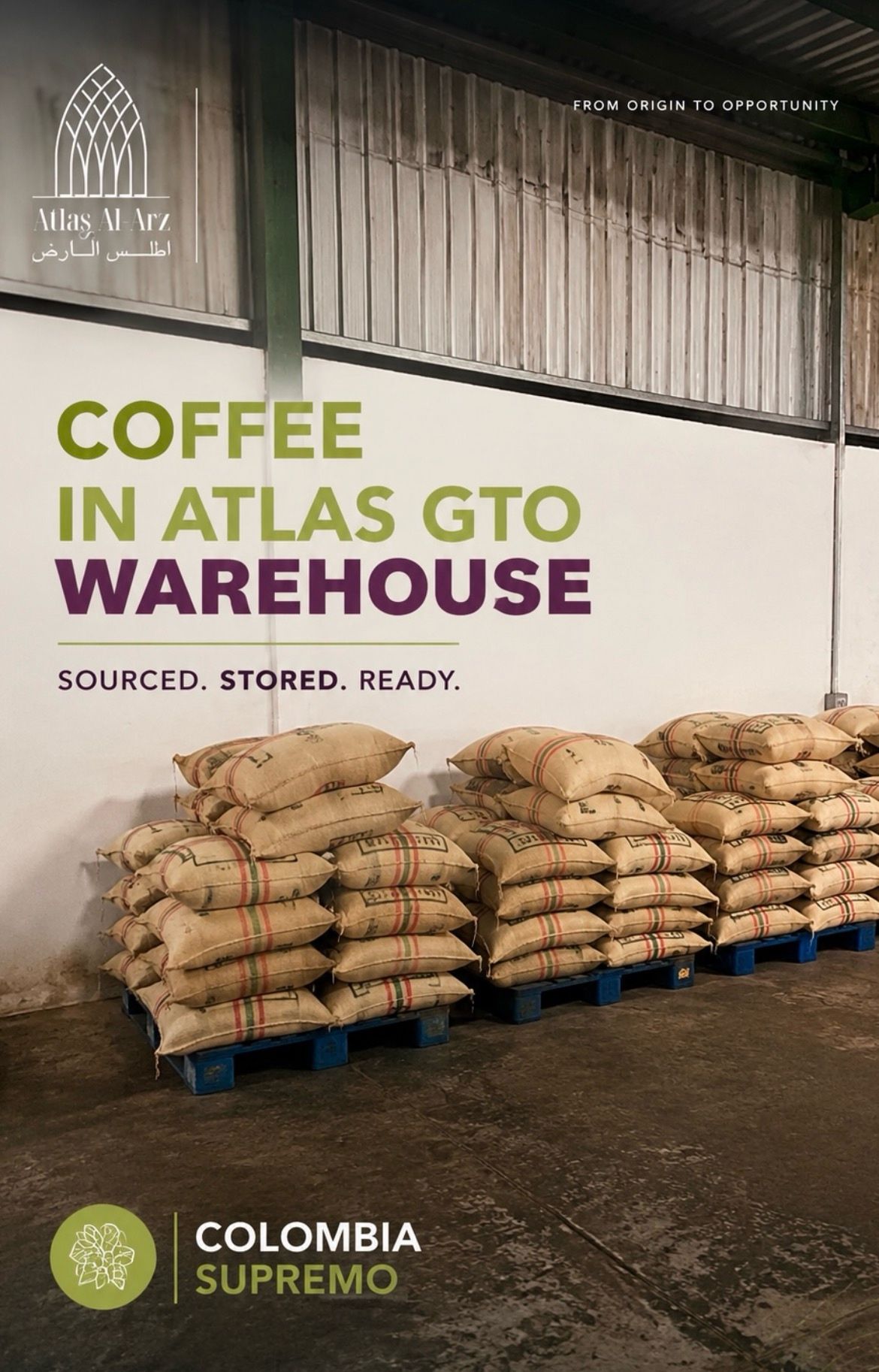
Our Colombia Supremo green coffee beans are now in stock at the Atlas GTO warehouse, ready to move from origin to GCC coffee businesses.
For us, green coffee trading is more than moving bags from one country to another. It is about building a reliable supply chain around origin, quality, specifications, logistics and commercial requirements.
At Atlas GTO, we source and supply green coffee for:
Our focus is simple: connect reliable coffee origins with businesses looking for consistent supply and commercially viable sourcing solutions.
From Origin to Opportunity
Discuss your green coffee requirementsThe ICO I-CIP rose from 250.82 on 24 September to 252.96 US cents/lb on 25 September, a 0.85% daily increase. Correction, 1 October: ICO revised the 25 September figure on 29 September; the original version used 253.05 (+0.89%). Newer observations are available in the dated ticker.
For roasters, importers and distributors in Oman, the UAE and Iran, use the benchmark as context when reviewing a fresh written quotation. Compare equivalent specifications, origin differentials, freight and shipment windows. A one-day rebound alone does not justify changing coverage: relate each purchase to expected consumption and confirmed delivery terms. Submit sourcing requirements through the website for transaction-specific review.
View the latest dated ICO indicators and recent observations
ICO daily indicators — 25 September 2026
The medium-term balance is improving, but the prompt physical market remains uneven. ICO projects a 3.0 million-bag global surplus for 2025/26, yet cumulative green-bean exports through July were still 0.4% lower year on year and certified Arabica stocks remained at a multi-decade low.
Use two procurement clocks. For the next 30–90 days, secure critical Arabica volumes only against verified physical stock, specification and shipment slots, while re-tendering Robusta across qualified origins as availability improves. For the following three to nine months, keep commitments staggered so the projected surplus can translate into better physical offers without leaving core requirements uncovered. Compare landed offers—not benchmark direction alone—including origin differential, quality, freight, finance, documents and delivery risk. None of these forecasts or futures indicators is a physical coffee offer.
The International Coffee Organization’s latest complete daily sheet shows the I-CIP at 250.82 US cents/lb on 24 September 2026, down 0.28% from 23 September. Colombian Milds fell 0.26% to 342.06 cents/lb, Other Milds 0.28% to 316.16, Brazilian Naturals 0.40% to 274.44 and Robustas 0.14% to 161.94. Brazilian Naturals recorded the largest percentage decline among the four group indicators.
For buyers in Oman, Iran, the UAE and the wider GCC, this modest broad decline partly reverses the previous day’s rebound but is not enough on its own to establish a new direction for physical coffee. Request supplier quotations dated after 24 September and compare the benchmark, origin differential, grade, cup result, freight, finance, shipment window and landed cost against the prior offer. Keep essential coverage tied to confirmed stock and loading capacity; ICO daily indicators are market references—not physical coffee offers.
View the latest dated ICO indicators and recent observations
Official source: ICO Indicator Prices — 24 September 2026The International Coffee Organization’s latest complete daily sheet shows the I-CIP at 251.53 US cents/lb on 23 September 2026, up 1.24% from 22 September. Colombian Milds rose 1.18% to 342.94 cents/lb, Other Milds 1.28% to 317.05, Brazilian Naturals 1.59% to 275.55 and Robustas 0.75% to 162.17. Brazilian Naturals recorded the largest percentage rise among the four group indicators.
For buyers in Oman, Iran, the UAE and the wider GCC, the broad rebound partly reverses the previous day’s decline but does not establish a new price trend or confirm that physical offers have risen equally. Request quotations dated after 23 September and compare the benchmark, origin differential, quality, freight, finance, shipment window and landed cost with the prior offer. Avoid changing coverage solely on one daily observation; confirm critical requirements against verified physical stock and loading capacity. ICO indicators are market references—not physical coffee offers.
View the latest dated ICO indicators and recent observations
Official source: ICO Indicator Prices — 23 September 2026The International Coffee Organization’s latest complete daily sheet shows the I-CIP at 248.44 US cents/lb on 22 September 2026, down 1.38% from 21 September. Colombian Milds fell 1.11% to 338.93 cents/lb, Other Milds 1.20% to 313.03, Brazilian Naturals 1.38% to 271.24 and Robustas 1.78% to 160.96—the largest percentage decline among the four group indicators.
For buyers in Oman, Iran, the UAE and the wider GCC, a second broad daily decline is a reason to refresh quotations rather than assume physical coffee has fallen by the same amount. Ask suppliers to separate the benchmark, origin differential, freight, finance and shipment timing in their offer; then compare the delivered cost against the previous quotation. Stage non-urgent coverage, but protect critical requirements against verified stock and loading slots. ICO daily indicators are market references—not physical coffee offers or proof of availability.
View the latest dated ICO indicators and recent observations
Official source: ICO Indicator Prices — 22 September 2026The International Coffee Organization’s latest complete daily sheet shows the I-CIP at 251.92 US cents/lb on 21 September 2026, down 2.65% from the previous published observation on 18 September. Colombian Milds fell 2.65% to 342.73 cents/lb, Other Milds 2.86% to 316.83, Brazilian Naturals 3.35% to 275.03 and Robustas 1.37% to 163.88.
For buyers in Oman, Iran, the UAE and the wider GCC, the broad one-day decline improves the benchmark backdrop for refreshing supplier negotiations, but physical offers may not move at the same speed. Request updated quotations dated after 21 September and compare the origin differential, grade, cup quality, freight, finance, shipment window and landed cost before changing coverage. Keep essential purchases staggered and treat these daily ICO indicators as market references—not physical coffee offers or proof of available stock.
View the latest dated ICO indicators and recent observations
Official source: ICO Indicator Prices — 21 September 2026The International Coffee Organization reports that exports of all forms of coffee from the Caribbean, Mexico and Central America fell 15.9% year on year to 1.39 million 60-kg bags in July 2026, the region’s third consecutive month of decline. Mexico and Nicaragua were the main drivers. Within green Other Milds, Nicaragua’s shipments fell 63.1% to 0.12 million bags, partly offset by increases from Guatemala and Honduras.
For buyers in Oman, Iran, the UAE and the wider GCC, the regional headline should not be treated as one uniform supply signal. Updated offers from Guatemala and Honduras may provide alternatives where Nicaragua or Mexico coverage is constrained, but origins and lots are not interchangeable. Compare crop, grade, screen, defects, moisture, process, cup profile, shipment slot and landed cost on the same basis, and keep essential washed-Arabica coverage diversified. These export statistics are market indicators—not physical coffee offers or proof of availability.
The International Coffee Organization estimates world coffee production at 183.6 million 60-kg bags in coffee year 2025/26, up 4.4%. Within that total, Arabica output is projected to rise 2.8% to 104.4 million bags, while Robusta output is estimated to increase 6.5% to 79.2 million bags.
For buyers in Oman, Iran, the UAE and the wider GCC, faster Robusta production growth supports a broader set of blending and cost-management options, but the global estimate is not proof of immediately available physical coffee. Plan Arabica and Robusta coverage separately; verify origin, crop, grade, screen, defects, moisture, cup compatibility, shipment window and landed cost before changing a blend or contract. Production forecasts and futures benchmarks are market indicators—not physical coffee offers.
The International Coffee Organization reports that global green-bean exports rose 6.3% year on year to 10.76 million 60-kg bags in July 2026. The increase was entirely driven by Robusta exports, which jumped 32.0% to 4.98 million bags, while total Arabica exports fell 8.9% to 5.78 million bags. Arabica’s share of cumulative green-bean exports in the first ten months of coffee year 2025/26 fell to 59.7%, from 63.6% a year earlier.
For buyers in Oman, Iran, the UAE and the wider GCC, the headline increase in global shipments should not be treated as broad relief across every coffee type. Robusta availability has improved faster, while prompt Arabica supply can remain comparatively tight. Recalculate blend economics by component, seek technically suitable Robusta alternatives from Viet Nam, Brazil and approved origins, and protect essential Arabica needs with verified physical offers and shipment slots. Confirm cup compatibility, grade, screen, defects, moisture, crop, freight and landed cost before changing a formulation. These export statistics are market indicators—not physical coffee offers.
The International Coffee Organization reports that Colombia exported 0.93 million 60-kg bags in July 2026, down 15.3% from 1.10 million bags in July 2025. The ICO links the decline to adverse weather during the first half of 2025, which disrupted flowering and cherry development, delayed the main 2025/26 harvest and reduced the subsequent Mitaca, or fly crop.
For buyers in Oman, Iran, the UAE and the wider GCC, the weaker July flow can keep prompt Colombian washed-Arabica availability and differentials firm even as the overall global balance improves. It does not prove that every Colombian lot is scarce, nor is the export statistic a physical offer. Confirm crop and harvest period, exporter stock, grade, screen, defects, cup profile and shipment slot; then compare the landed cost with technically suitable washed coffees from Honduras, Guatemala and other approved origins before contracting.
The International Coffee Organization’s statistics update of 10 September estimates world coffee production at 183.6 million 60-kg bags in coffee year 2025/26, up 4.4%, while consumption is estimated to decline 0.8%. The resulting balance is a projected surplus of 3.0 million bags, following four consecutive deficit years from 2021/22 through 2024/25.
For buyers in Oman, Iran, the UAE and the wider GCC, the projected global surplus improves the medium-term supply backdrop but should not be read as immediate availability of every origin, grade or shipment window. Near-term Arabica supply can remain tight even while the aggregate balance turns positive. Keep contracts staggered, compare Arabica and Robusta requirements separately, verify crop-specific physical availability and refresh landed-cost offers. This ICO balance is a market estimate—not a physical coffee offer or a guarantee of lower prices.
USDA’s Jakarta office forecasts Indonesia’s green-bean production at 11.38 million 60-kg bags in 2026/27, down 8% year on year. The report attributes the decline mainly to excessive rainfall during flowering and fruit development in Robusta areas of southern Sumatra and Java, and projects green-bean exports at 7 million bags.
For buyers in Oman, Iran, the UAE and the wider GCC, this forecast adds supply risk to one of Asia’s important Robusta origins. It does not mean every Indonesian physical offer will rise, nor is the forecast itself an offer. Compare Indonesia coverage with Viet Nam, Brazil and Uganda on equivalent grade, screen, defects, process and shipment timing; request crop-specific samples, confirm the exporter’s available volume, and keep essential Robusta requirements staggered across more than one origin.
Uganda’s Ministry of Agriculture, Animal Industry and Fisheries reports that the country exported 8.6 million 60-kg bags from June 2025 through May 2026, up from 7.4 million bags in the comparable previous period. Export earnings reached US$2.3 billion, an 11% increase, supported by higher volumes and sustained international demand.
For buyers in Oman, Iran, the UAE and the wider GCC, Uganda’s stronger export capacity adds a practical diversification option beyond the largest Latin American and Asian origins—especially for Robusta, while selected Arabica profiles can also be evaluated. The headline growth is not a physical offer or a guarantee of availability. Compare representative samples and written specifications, confirm crop year, grade, screen, defects, moisture, Incoterm, documentation and shipment window, and benchmark the landed cost against comparable lots from Viet Nam and Brazil before contracting.
Cecafé reports that Brazil shipped 4.155 million 60-kg bags of all forms of coffee in August 2026, 31.0% more than a year earlier and the highest August volume on record. Arabica exports rose 25.7% to 2.866 million bags, while Conilon and Robusta shipments increased 53.6% to 953,592 bags.
For buyers in Oman, Iran, the UAE and the wider GCC, the stronger flow improves the opportunity to compare fresh Brazilian Arabica and Canephora offers, but it does not imply an automatic 31% reduction in physical prices. Ask suppliers to confirm available crop, grade, screen, defects, shipment slot and validity of the differential; Cecafé also warns that port infrastructure constraints continue to delay shipments and add costs. Re-tender comparable specifications, keep coverage staggered and base landed-cost decisions on an actual physical quotation rather than the export headline or a futures benchmark.
The International Coffee Organization reports that Viet Nam exported 2.40 million 60-kg bags of Robusta in July 2026, up 87.4% from 1.28 million bags in July 2025. Together with an 83.7% rise in Brazilian Robusta shipments, this helped lift global Robusta exports by 32.0% year on year to 4.98 million bags.
For buyers in Oman, Iran, the UAE and the wider GCC, the stronger flow improves the near-term choice of Robusta origins, but it is not proof that every physical offer should fall by the same percentage. Compare fresh Viet Nam and Brazil quotations on equivalent grade, screen, defects, crop, shipment window, freight and payment terms. Use the increased availability to create supplier competition and stagger coverage, while keeping quality approval tied to a representative sample.
This week’s evidence points to a divided market rather than a single direction. Near-term Arabica availability remains tight, while Robusta export flows and London-certified stocks are rebuilding. Weather expectations and Brazil’s crop commercialization can still reverse benchmark moves quickly.
Run separate coverage plans for Arabica and Robusta. Protect essential near-term Arabica requirements with confirmed physical offers and delivery slots, but keep later purchases staggered because improved Brazilian supply expectations may create better entry points. Re-tender Robusta requirements across Viet Nam and Brazil as availability improves. For every decision, reconcile the benchmark with origin differential, quality, freight, finance, documents and actual shipment timing. Maintain an operational safety buffer for critical SKUs; none of the cited indicators is a physical coffee offer.
The International Coffee Organization reports that its Composite Indicator Price averaged 287.29 US cents/lb in August 2026, virtually unchanged from July’s 287.26. The monthly average concealed a mid-month rally supported by heightened El Niño concerns and tight near-term Arabica supplies, followed by a reversal as favourable Brazilian rainfall and improved supply expectations reduced upward pressure.
For buyers in Oman, Iran, the UAE and the wider GCC, a flat monthly average should not be treated as price stability. Budget and contract reviews should use the actual quotation date, origin differential and delivery window rather than the monthly mean alone. Keep purchasing staggered, refresh supplier offers after sharp weather-driven moves, and compare physical Arabica and Robusta lots separately. The I-CIP is a market indicator, not a physical coffee offer.
Reuters reports that coffee traders are seeking to certify at least 300,000 bags of Brazilian Arabica for ICE warehouses ahead of the December contract. ICE-certified Arabica stocks have fallen below 220,000 bags, a 26-year low. More than 62,000 Brazilian bags had already reached exchange depots for grading, but it remains uncertain how many will pass certification.
For buyers in Oman, Iran, the UAE and the wider GCC, rising certified stocks could place downward pressure on the Arabica futures benchmark, but they do not guarantee an equivalent or immediate reduction in physical coffee offers. Monitor accepted—not merely submitted—volumes, then compare the futures move with origin differentials, quality, crop timing, freight and payment terms. Keep purchasing in stages and request refreshed physical quotations before changing landed-cost assumptions.
The European Commission confirms that coffee is covered by the EU Deforestation Regulation. Operators placing covered products on the EU market must show that they are not linked to recent deforestation or forest degradation. The rules apply to large and medium operators from 30 December 2026 and to micro and small operators from 30 June 2027.
For buyers in Oman, Iran, the UAE and the wider GCC, this is not a statement that EU law directly governs local imports. It is a procurement signal: suppliers serving both Europe and the Gulf may increasingly standardize plot-level traceability and due-diligence documentation across all lots. Ask for farm or polygon identification, harvest and lot records, chain-of-custody evidence and a written compliance status early in negotiations. Better documentation can widen supplier choice and reduce the risk of delays, substitutions or unexpected premiums.
The ICO’s July 2026 Coffee Market Report shows the I-CIP averaging 287.26 US cents/lb, up 15.4% from June. Colombian Milds rose 18.1% to 383.39 cents/lb while Robustas rose 9.1% to 184.78 cents/lb. The New York–London arbitrage widened 36.4% to 137.61 cents/lb.
For buyers in Oman, Iran, the UAE and the wider GCC, Arabica and Robusta should now be budgeted and contracted as distinct risk pools. Recalculate landed-cost scenarios, confirm the physical differential and delivery window with each supplier, and avoid treating a lower Robusta benchmark as evidence that every blend or Arabica lot should be cheaper. The ICO indicators and futures references are market benchmarks, not physical coffee offers.
The International Coffee Organization reports that world coffee exports reached 12.23 million 60-kg bags in July 2026, up from 11.84 million a year earlier. Total exports for the first ten months of coffee year 2025/26 remained almost unchanged at 118.39 million bags.
The headline stability hides a shift in the supply mix. Over the twelve months ending July, Arabica exports fell from 86.37 to 80.96 million bags, while Robusta increased from 54.67 to 60.01 million. Regional buyers should therefore separate overall availability from grade-specific availability when planning contracts and inventory.
Practical sourcing support for green coffee buyers in Oman, the UAE and the wider GCC.
Oman’s ports and logistics hubs, including Sohar, support import routes for green coffee from origins such as Brazil, Colombia and Ethiopia, with onward access to the UAE and other regional markets. Atlas gives buyers one Gulf-based point of contact for evaluating supply options across origins.
Working with a Muscat-based trading partner keeps supplier evaluation, documentation, commercial terms and shipment coordination within a familiar regional framework.
Café groups, hotels and independent roasteries in Dubai, Abu Dhabi, Muscat and other Gulf cities need green coffee that matches their quality, volume and delivery requirements. Price matters, but consistency, documentation and shipment timing also shape a workable purchase.
Atlas compares suitable suppliers and origins against the buyer’s specification, helping regional businesses evaluate quality, availability, lead time and landed cost before committing.
Atlas can support supplier evaluation, sample coordination, commercial comparison, documentation and shipment planning for Oman, the UAE and neighbouring markets. Each request begins with the preferred origin or cup profile, volume, crop requirements and delivery destination.
Send your target volume, preferred origin or cup profile, destination city and required delivery window. We will review the brief and return relevant sourcing options and next steps.
Oman’s commercial gateways, including Sohar, Salalah and Duqm, offer different routing options for regional cargo. The suitable route depends on the coffee’s origin, available sailing, destination, customs requirements, storage needs and required delivery window.
Before a purchase is confirmed, Atlas can compare the available route, expected transit time, Incoterm, handling requirements and export and import documents against the buyer’s delivery brief.
Raw green coffee is an unroasted agricultural bean and is not typically classed as requiring its own halal certificate, since it contains no animal-derived or alcohol-based inputs. Gulf buyers are nonetheless asking suppliers for stronger quality documentation, plus — where the coffee will be flavored, processed or co-packed downstream — a written halal or food-safety declaration covering those later stages before it reaches ports in Oman, the UAE and the wider GCC.
Atlas requests a written quality specification (screen size, defect count, moisture, cup score) and a phytosanitary certificate from every supplier, and adds a halal or food-safety declaration whenever a buyer’s downstream flavoring, processing aids or shared production line requires one. Asking for this documentation before the sample stage, rather than after shipment, gives buyers time to compare suppliers on more than price and helps avoid delays at the port of entry.
Brazil, Colombia and Ethiopia harvest at different points in the year, so the freshest, most competitively priced lots from each origin become available in separate windows rather than year-round. Buyers in Oman, the UAE and the wider GCC who plan purchase requests around origin-specific harvest and export timing — rather than ordering only once local stock runs low — get better access to the current crop and a stronger negotiating position on price and specification.
Atlas tracks the main harvest and export windows across its sourcing origins and flags to buyers, well before a stock shortage, when a new crop year is becoming available at origin. Aligning a purchase request with the start of an origin’s export season, rather than the point of local need, gives buyers earlier access to fresher lots, more supplier options and more room to negotiate on price and delivery terms.
Most espresso-style and traditional Gulf coffee blends combine Arabica and Robusta in different ratios depending on the target cup profile, price point and local drinking habits — from Turkish- and Arabic-style preparations to specialty espresso menus. Buyers who define the intended blend and cup profile before requesting a quotation get more accurate pricing and avoid receiving a lot that technically meets a specification but does not perform as expected in the cup.
Atlas sources both Arabica and Robusta lots and can propose a blend ratio based on the buyer’s target price point, body and caffeine strength, rather than leaving species selection to guesswork. Before confirming an order, we recommend cupping a representative sample of the intended blend — not just the individual origins — since flavor and body can shift once lots are combined.
Building a Gulf blend? See what to specify when sourcing green coffee from Brazil.
Most first-time buyers do not move straight from an inquiry to a full container order. A typical path runs from a roasted evaluation sample, to a small trial order sized for a single roasting run, to a first partial or full container once quality and consistency are confirmed across two or three shipments.
Atlas structures each stage with a clear volume and a fixed decision point, so a buyer can stop or scale up after every shipment rather than committing to a full container on the first order. We recommend agreeing crop-year consistency and defect tolerances in writing at the sample stage, since that is what a later, larger order will be measured against.
Letters of credit, partial advance payment and supplier credit each shift cost, risk and cash-flow timing differently between a Gulf buyer and its coffee supplier, and the right choice usually depends on order size, relationship history and how quickly the buyer needs to free up capital for the next purchase. A first-time buyer with no track record will typically face different terms than one placing a fourth or fifth repeat order with the same supplier.
Atlas structures payment terms case by case, weighing a buyer’s cash-flow needs against a supplier’s own risk tolerance, and can suggest staged or partial-advance structures for new relationships that reduce upfront exposure on both sides. Buyers who ask about financing options early — before a specification is finalized — usually have more room to negotiate volume, price and delivery timing together.
Green coffee is a living agricultural product: it keeps absorbing moisture and odors from its environment long after arrival, and Gulf summer heat and humidity make poor storage conditions far more damaging than in temperate markets. Beans held too long in non-climate-controlled warehouses can lose cup quality, develop off-flavors, or fall out of specification before a single bag is opened.
Atlas recommends buyers confirm warehouse conditions — temperature, humidity control, ventilation and stacking practice — before agreeing to long storage periods at origin or in transit, and to ask suppliers for moisture readings at the point of loading, not only at harvest. Matching order size to actual consumption speed, rather than buying further ahead than storage conditions can support, protects quality more reliably than any single certificate.
Buyers who rely on a single origin can face gaps when a harvest is delayed, a shipping lane is disrupted, or a specific lot sells out. Vietnam and Indonesia offer well-established Robusta and some Arabica supply on different harvest calendars than Latin America, while Kenya adds a distinct high-grown Arabica profile — each a way to widen the supplier base rather than replace it.
Atlas evaluates a new origin the same way as an existing one: verified samples, documented specifications and a trial order before any volume commitment. Adding a second or third origin to a buyer’s supplier list is usually about continuity of supply and negotiating leverage, not simply chasing a lower price, and works best when planned ahead of a shortage rather than during one.
Green coffee is priced and settled internationally in US dollars, so a buyer’s own currency matters as much as the commodity price itself. Oman’s rial and the UAE dirham are pegged to the US dollar, which removes one layer of currency risk on conversion, but the underlying USD coffee price can still move sharply between quotation and payment. Buyers converting from currencies without a dollar peg, including the Iranian rial, face an additional and separate layer of exchange-rate risk on top of any change in the coffee price itself.
Atlas recommends buyers separate commodity price risk from currency risk in their own planning, rather than treating a landed-cost estimate as a single number that moves for one reason. For pegged-currency buyers, locking a price at the quotation date protects against commodity moves; for buyers converting from a floating or restricted currency, the exchange rate itself should be confirmed and, where possible, secured through the buyer’s own bank at or before contract signing, not assumed at the rate seen when the inquiry was first made.
Green coffee sold internationally is typically split into commercial grades — mainstream, consistent, suited to larger-volume roasting — and specialty grades, with higher cup scores, tighter defect tolerances and often traceable to a single farm or lot. The two grades are priced and used differently, and buying the wrong one for the intended product usually shows up later, either in cup quality or in an unnecessarily high landed cost.
Atlas asks buyers to define the intended shelf or menu position before requesting a quotation, since a specification built for commercial volume will not match a specialty program’s defect tolerance, moisture and cup-score requirements, and the reverse mismatch wastes budget on quality the buyer’s product does not need. Confirming the grade, defect count and minimum cup score in writing at the sample stage keeps the later order aligned with what the buyer actually intends to sell.
A container of green coffee travels for weeks by sea and inland transport before reaching Oman, the UAE or another Gulf port, and standard Incoterms do not always make clear which party is responsible for insuring the cargo at each stage. Buyers who assume the shipping line or the seller has covered losses in full are sometimes surprised to learn that basic liability cover falls well short of the coffee’s actual value.
Atlas confirms who is responsible for cargo insurance under the agreed Incoterm before shipment, and recommends buyers insure at the coffee’s full commercial value — not just the invoice amount — since a partial loss from wetting, contamination or container damage is settled against the insured value, not the replacement cost. Ask for the insurance certificate, the named clauses (such as Institute Cargo Clauses A, B or C) and the claims process in writing before the goods are loaded, not after a problem is discovered at the port.
Brazil’s frost and drought cycles, El Niño-linked rainfall swings in Vietnam and Indonesia, and altitude-dependent harvest windows in Ethiopia and Kenya do not move in the same direction at the same time. A buyer who tracks only one origin’s weather season is exposed to a shock that a second, uncorrelated origin might not share.
For buyers in Oman, the UAE and Iran, compare harvest timing, supplier updates and shipment windows for each proposed origin. Evaluate and approve samples from an alternative origin before relying on it as backup. Agree a realistic delivery allowance and review availability, specifications and costs for each inquiry; diversification can reduce exposure but does not guarantee uninterrupted supply.
Bulk purchasing and traceability are not opposites. A commercial lot may combine coffee from several farms, while its records can still identify a country, region, cooperative or individual lot. A single-origin label alone does not establish farm-level traceability. Ask what level of origin detail is documented and whether the lot code connects the sample, offer and shipment; compare any additional cost against your actual requirements.
Atlas asks buyers early whether their own customers or product story require single-origin traceability, since that decision shapes which suppliers and lots are even available to quote. Requesting the required traceability level in writing before the sample stage — rather than assuming it can be added later — keeps the later order aligned with what the buyer can actually document to their own market.
The GCC has a common customs law and external tariff. This does not replace checking the requirements for a particular green-coffee shipment. Before quoting, confirm the applicable HS classification, origin, duty or exemption treatment, importer registration and any permits or clearance documents required by the destination authorities. Do not assume paperwork from an earlier shipment is sufficient for a new destination or importer.
Atlas can help coordinate a review of destination requirements with the buyer, importer and customs broker before a landed-cost estimate is finalized. Buyers entering a new GCC market should request written confirmation at the quotation stage and recheck requirements before shipment. Final classification, duties and release remain subject to the competent authorities.
Buying green coffee directly from an origin exporter can offer a lower quoted price, but the buyer still needs to arrange supplier checks, documentation, shipping and quality acceptance, either in-house or with specialist support. A regional trading partner can help coordinate these tasks for an agreed fee or margin. Compare the full landed cost and each party’s responsibilities, and verify the partner’s supplier relationships and problem-resolution record rather than assuming them.
When discussing sourcing with Atlas, agree in writing what origin-supplier and shipment information will be shared, who handles each stage and how quality or delivery issues will be addressed. The appropriate route depends on order volume, in-house sourcing capacity and the risks the buyer is prepared to manage directly, not only the price on a single invoice. Information access, services and responsibilities should be confirmed for each transaction.
Home espresso commonly uses a small basket and a short extraction, often around 18–20 g of ground coffee in 20–30 seconds. A two- or three-group café machine serves much higher volume and has different installation, workflow and consistency requirements. The same coffee can present differently across these settings, so the end customer’s brewing equipment should inform the buying brief.
Atlas asks not only about volume, but also how the coffee will be brewed. A roastery serving home-espresso customers may need a different green-coffee specification, density range, processing style and roast-development target from a café group making repeated commercial extractions. The final brew method helps shape a sourcing conversation from producer to buyer; origin, process, roast profile and performance should be evaluated with samples for each specific programme.
Incoterms® 2020 rules allocate delivery, cost and risk responsibilities between seller and buyer; they do not replace the sale contract. Under FOB, the seller delivers when the goods are onboard the buyer-nominated vessel at the named port of shipment. Under CFR and CIF, the seller contracts and pays for carriage to the named destination, but risk still transfers when the goods are onboard at shipment. CIF also requires the seller to arrange the specified insurance cover; CFR does not.
FOB (Free On Board) means the seller clears the coffee for export and delivers it on board the vessel the buyer has nominated at the named port of shipment, for example FOB Santos. From that moment the buyer carries the risk and pays the main sea freight and any cargo insurance it chooses to arrange; FOB does not itself require either party to buy insurance.
CFR (Cost and Freight) means the seller contracts and pays for carriage to the named port of destination, for example CFR Jebel Ali. Risk still passes to the buyer when the coffee is on board at the port of shipment, so a CFR buyer should consider arranging cargo insurance from that point.
CIF (Cost, Insurance and Freight) adds seller-arranged cargo insurance to the carriage responsibilities under CFR. The standard Incoterms® 2020 arrangement uses Institute Cargo Clauses (C) or similar cover, subject to a different agreement or trade custom. The insured amount must be at least 110% of the contract price, in the contract currency. Check the agreed policy and any additional cover. Risk still passes on board at shipment, not on arrival.
The key difference is the seller’s insurance obligation under CIF. Under CFR neither party is obliged by the rule to purchase insurance, so the buyer should consider its own cover. Under CIF the seller arranges the agreed cover, whose exclusions may leave gaps. Compare offers on the same named destination port and confirm the insurance clause and any extra cover before agreeing the contract.
FOB, CFR and CIF are rules for sea and inland waterway transport where goods are loaded on board a vessel. When green coffee is handed to the carrier in a container at a terminal before loading, ICC guidance points to FCA, CPT or CIP instead. Agree the rule, the named place and the Incoterms® version in the contract.
The buyer normally contracts and pays for the main sea carriage from the named port of shipment. The seller handles delivery on board and export clearance where applicable. Other documentation, assistance and exceptional costs follow the detailed rule and the agreed contract; on-board delivery does not end every seller obligation.
When the coffee is on board the vessel at the port of shipment, even though the seller pays freight and insurance to the destination.
No. Incoterms® rules cover delivery, costs and risk. Price, payment, quality, quantity tolerances and transfer of ownership must be agreed in the contract.
A meaningful comparison puts quotations on the same named place, Incoterms® version and cost basis. Atlas can help buyers compare supplier quotations and identify freight, insurance and destination charges that still need confirming. Ask for the complete term, named port and Incoterms® 2020 in writing; the contract, insurer, carrier and relevant authorities determine the final obligations and charges for each shipment.
ICC — Incoterms® 2020 delivery and risk guidance
Organic, Rainforest Alliance and Fairtrade certification each covers a defined standard and scope. Organic certification verifies compliance with the named organic regulation for the certified operation. Rainforest Alliance certification covers farm and supply-chain requirements on environmental, social and responsible-business practices. Fairtrade’s coffee standard covers trade, production and business requirements, including applicable minimum-price and premium mechanisms. None of these certificates establishes cup quality, screen size, defects or present availability; each lot still needs its own specification, traceability and cupping review.
Organic certification confirms that the certified operation produces and handles coffee under a named organic regulation, checked by an approved control body. Rainforest Alliance certification covers the applicable farm standard and supply-chain requirements; its shared supply-chain requirements apply to volumes certified under the Sustainable Agriculture Standard, the Regenerative Agriculture Standard, or both. Fairtrade certification applies the Fairtrade Standards to producer organisations and traders, including the Fairtrade Minimum Price and Premium arrangements for coffee. None of them is a cup-quality grade.
Ask for the certificate holder's name, the certificate scope and its validity dates, and check the relevant official or certification-body directory where available. Ask the certification body to clarify any uncertainty about current status or scope. Then make sure the lot itself is sold as certified on the contract and the shipping and transaction documents. A farm or exporter holding a certificate does not make every lot it sells certified.
Atlas asks buyers whether a certificate is required by their customer, regulator or retail partner before sourcing begins. The answer determines which certificate, certificate-holder and chain-of-custody evidence must be requested. Certificate scope, validity, lot linkage, price and availability must be confirmed for each transaction; certification is an additional specification field, not a substitute for origin, processing, crop year or quality control.
USDA Agricultural Marketing Service — Organic certification
Rainforest Alliance — Sustainable Agriculture Standard terms
Fairtrade International — Coffee Standard for Small-scale Producer Organizations
European Commission — organic controls
Rainforest Alliance — Supply Chain Requirements v1.5 (binding 2026-03-01)
The time between signing a green coffee contract and having the beans in a Gulf warehouse is longer than the sea voyage alone. It usually includes milling and bagging at origin, pre-shipment sample approval, export paperwork, securing space on a vessel, a transit that may involve transhipment at a regional hub, and import clearance on arrival. When vessel space is tight, a container can also be rolled to a later sailing, adding days or weeks with little warning.
Atlas can help plan an order backward from the date the roaster needs the coffee in stock, and confirm the booking, planned vessel and any transhipment port with the buyer before the coffee leaves origin. Buyers should place their next order well before current stock runs low, keep a safety buffer of green coffee on hand, and avoid tying a new blend launch or seasonal promotion to a single shipment. Schedules remain subject to the shipping line and port operations.
Green coffee is traded by crop year, and when a new harvest reaches the market, lots from the previous year are often offered as past crop, sometimes at a lower price. Green coffee slowly loses freshness and moisture over time, and lots held in plain jute in warm conditions can develop flat, woody or baggy flavours. Before accepting a past-crop offer, ask in writing for the crop year, packing date and storage conditions, and approve a fresh sample from that lot rather than an old one.
A past-crop lot is not automatically a poor buy: a well-stored coffee intended for a darker roast or as a blend component can still make commercial sense at the right discount. Atlas can help buyers check the crop year, packing date and storage history of a lot and compare it with new-crop alternatives, so the price difference reflects the real change in quality.
An independent pre-shipment inspection sends a third-party surveyor to the loading point to verify quantity, packaging, moisture, screen size and visible defects against the sales contract before the container is sealed. Skipping this step means the first real check against specification often happens only after the shipment has reached a port in Oman, the UAE or the wider GCC, when a mismatch is harder and more expensive to resolve.
For a buyer’s first order with a new supplier, or any order where a mismatch would be costly, Atlas can help identify the inspection requirements to agree before loading. The buyer and supplier should confirm the inspection body, who pays and the exact specification being checked in writing, so an origin report can be used if a later dispute arises.
Green coffee can lose or gain moisture as humidity and temperature change during sea transit, so its loading and discharge weights may differ. A modest change can occur in normal transit, but a material shortage can also indicate packaging, container-condition or handling issues. The contract should distinguish these possibilities before the shipment moves.
Before loading, the buyer and supplier should agree a weight tolerance, where and how moisture and weight will be recorded, and the evidence required if a shortage is disputed. Atlas can help buyers identify the questions to include in that agreement. Record the gross weight and moisture reading at loading, then arrange an independent reweighing or inspection at discharge where appropriate; the agreed contract and applicable terms determine any claim.
Coffee from a country that exports as a member of the International Coffee Organization is typically documented with an ICO certificate of origin, which records the shipment against that country’s reported export statistics. Coffee from a non-member exporting country moves without this specific certificate, and the paperwork a Gulf buyer should expect — and request — differs accordingly, even when the underlying quality, variety and processing are unrelated to membership status.
Atlas confirms each origin’s ICO membership status before finalizing a documentation checklist with a supplier, rather than assuming every lot will carry the same certificate of origin. For buyers evaluating a new, less familiar origin, we flag early whether export statistics and historical trade data are published through ICO reporting or whether comparable information needs to be sourced directly from the exporter or a trade body in that country.
Each coffee-producing country uses its own grading vocabulary, built around different measures — screen size in Kenya’s AA/AB/PB system, defect count in Ethiopia’s Grade 1 to Grade 5 scale, and bean size paired with growing altitude in Colombia’s Supremo and Excelso classifications. A top grade in one country’s system does not automatically match a top grade in another’s, and assuming otherwise can lead a buyer to expect a cup profile or defect tolerance the lot was never specified against.
Atlas asks every supplier to state both the origin’s local grade and the underlying measurements behind it — screen size, defect count, altitude band and processing method — rather than relying on the grade name alone to compare lots across countries. Buyers moving between origins for the first time should request a side-by-side specification sheet before cupping, so a quality decision is based on the same measured criteria rather than on two different national labels that happen to sound similarly premium.
Emergency freight surcharges, a changed discharge port or extra trucking can add cost and time to a green coffee shipment after the contract is signed. The Incoterms rule sets the baseline: under CFR or CIF the seller contracts the carriage, under FOB the buyer does, and each rule lists its costs in articles A9 and B9. Who pays for a surcharge or detour that arises later depends on the sale and carriage terms both sides agreed, so it is worth settling in writing before booking.
Atlas recommends agreeing three points in writing before a container is booked: how any later carrier surcharge or rerouting cost will be handled, which alternative discharge ports and onward trucking routes the buyer will accept, and whether the cargo insurance includes war and strikes cover. Buyers may also keep a safety stock sized to their own usage rather than ordering just in time, and should confirm the current route with the forwarder at booking, not at loading.
Incoterms 2020 — International Chamber of Commerce (costs listed at A9/B9)
To choose a green coffee beans supplier in the UAE, compare offers on the same written specification, approve a sample from the lot you will actually receive, and confirm the named delivery point, documents and payment terms before the first order. A low price per kilo means little if the delivery basis, crop year or defect allowance differs from the next quotation. Check these points in writing with every supplier you consider, local or overseas.
Write down origin, species, crop year, process, screen size, maximum moisture, defect allowance, bag type and quantity, and send the same sheet to every supplier. Offers built on different specifications cannot be compared fairly, and the specification later becomes the standard an arriving lot is judged against.
Ask for a pre-shipment sample drawn from the actual lot offered, not a general type sample, and roast and cup it against your own reference. Keep part of the approved sample sealed and labelled with the lot reference, and agree in the contract what happens if the arriving coffee does not match it.
A price to Jebel Ali, Abu Dhabi, another port in the Gulf or your own warehouse covers different costs and responsibilities. Green coffee bound for the UAE can arrive through different ports and overland legs, so ask which named place the price covers, which Incoterms® rule applies, who arranges each leg and who clears the goods for import.
Ask which shipping and food-safety documents the supplier will provide, such as the commercial invoice, packing list, bill of lading, certificate of origin and the health or phytosanitary certificate required for food consignments. Dubai Municipality has said each imported food shipment is accompanied by a health certificate issued by a government health authority in the country of origin; confirm the current list for your emirate with your clearing agent.
Confirm the supplier’s legal company name and check that the same entity appears on the contract, invoice and shipping documents. Agree payment terms, quote validity, and how quality or weight claims will be raised and settled before any money moves.
Origin, crop year, grade or screen size, moisture, defect allowance, packing, quantity, the Incoterms® rule with its named place, payment terms and how long the price is valid.
Not necessarily. Some suppliers ship from origin and some hold regional stock. Ask where the offered lot is now and what lead time to your receiving point the quotation confirms.
Yes, when the delivery basis, the party responsible for import clearance and the documents are agreed in writing. Compare its delivered cost with local offers on the same receiving point.
Atlas recommends comparing at least two offers line by line before a first UAE order, with the receiving point and import-clearance responsibilities written into each. Atlas is based in Oman and can help UAE roasteries and coffee businesses set out a comparable specification and review offers; price, availability, lead time and terms are confirmed only in a written quotation for each transaction.
Gulf News — How Dubai sources and manages food supplies from other countries
Khaleej Times — Sharjah–Oman logistics corridor, first three months
A telex release lets the buyer collect green coffee at the destination port without the original bill of lading, because the shipper hands the originals back to the carrier at origin and the carrier sends a release instruction to its destination office. An original bill of lading works the other way: the cargo is released only to whoever presents it. Which one you use decides who holds control of the coffee while it is at sea and how fast it can leave the port, so agree it in writing before the first shipment.
A bill of lading is the carrier’s receipt for the cargo, the contract of carriage and, when it is issued in negotiable form, a document of title. The carrier normally releases the cargo only against an original from the full set. For a seller this is security: the coffee cannot be collected until the buyer, or the bank acting for the buyer, holds the originals. For a buyer the cost is time, because the originals have to travel by courier or through a bank, and a short sea route can arrive before the paperwork does.
With a telex release the shipper surrenders the full set of original bills of lading to the carrier or its agent at the port of loading. The carrier then sends a release instruction, today usually electronic, to its office at the destination, and the consignee collects the cargo without presenting an original, normally with proof of identity and a delivery order. The title function of the bill of lading is not used. The coffee can leave the port as soon as the vessel is in and customs are cleared, which avoids storage and demurrage charges caused by late documents.
Once the originals are surrendered, the seller no longer controls the cargo through the documents. For that reason a telex release is usually agreed only when payment has already been received, or when the parties trade on settled terms and trust each other. If the buyer expects to resell the coffee while it is at sea, or the bank needs documents, a negotiable original bill of lading is the safer choice. A sea waybill is a third option: it is not a document of title, needs no original, and names the consignee directly.
Banks working with documentary credits generally require the original bill of lading to be presented, so a telex release and a letter of credit do not normally go together unless the credit itself allows it. If the supplier surrenders the originals, there may be nothing left to present to the bank. Check the credit terms and the requirements of both banks before you agree the release method, and ask your freight forwarder to confirm what the carrier accepts for the route.
It is a carrier instruction, sent from the origin to the destination office, that allows the consignee to collect the cargo without presenting an original bill of lading, because the shipper has already surrendered the originals.
It removes the seller’s control over the cargo through the documents, so it is normally used only after payment is confirmed or between trusted parties on settled payment terms.
Usually not, because banks generally ask for the original bill of lading. Check the credit terms and the requirements of both banks before agreeing it.
Atlas recommends writing the release method into the contract next to the Incoterms® rule and the payment terms, rather than leaving it to the freight forwarder at the last minute. Atlas is based in Oman and can help set out the document list in a quotation; the release method, price, availability and terms are confirmed only in writing for each transaction.
SeaRates — Telex release, express release and original bill of lading: when to use each option
For sourcing, supply or distribution inquiries, contact Atlas Earth. Share your product, origin, required volume and destination to start the conversation.